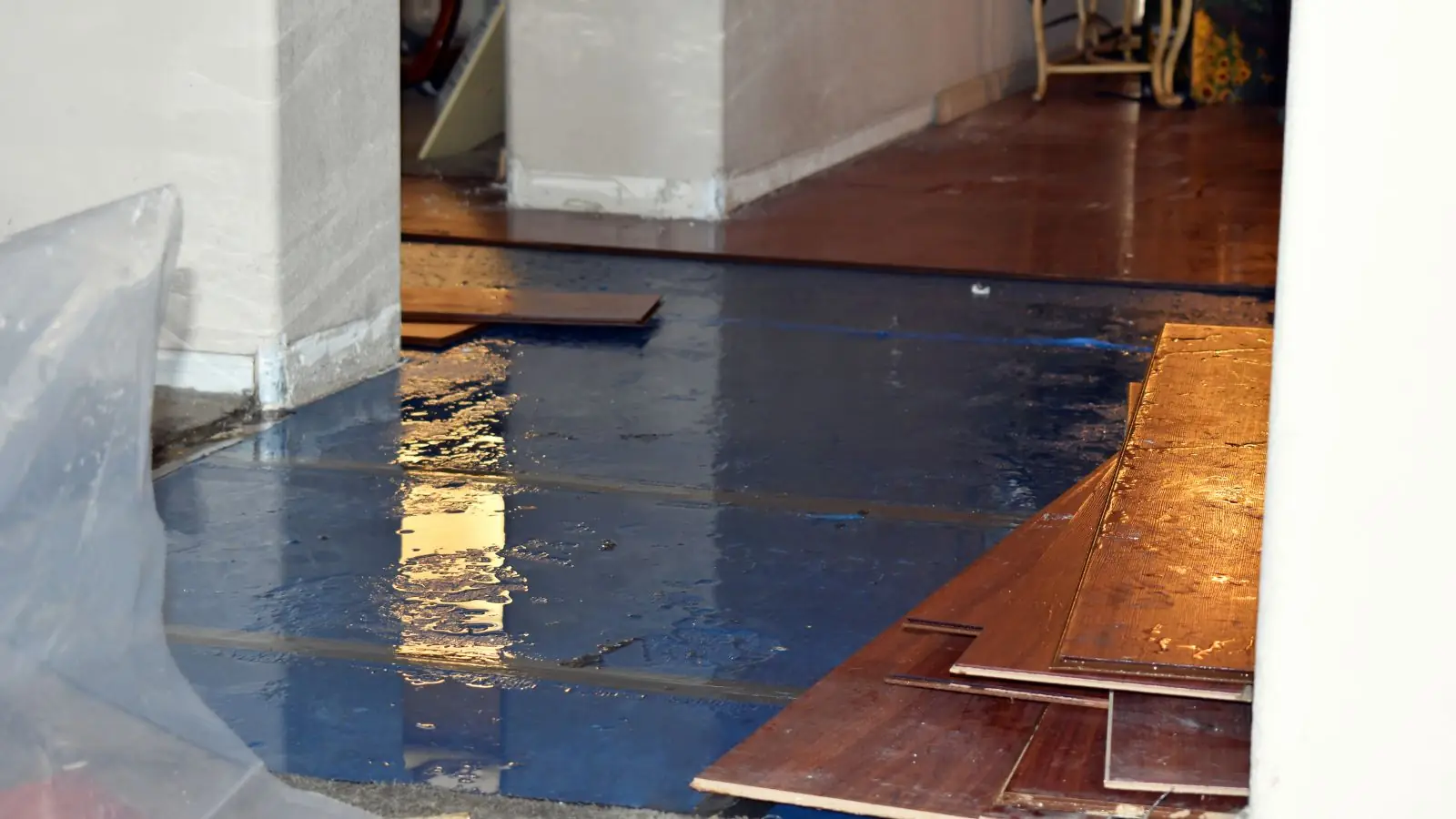
Can water damaged hardwood floors be saved?
Sometimes, yes. Hardwood that got wet from a clean source, such as a supply line or a short appliance leak, can often be dried in place if the water is removed quickly and the boards and subfloor are dried with controlled airflow. Hardwood that sat in water for days, or was touched by sewage or flood water, usually has to come up.
Wood absorbs water slowly and releases it slowly. That is why a floor can look fine for a day and then begin to cup, with edges rising higher than the centers of the boards, or crown, with the centers rising instead. Both are signs the wood took on more moisture than it can shed on its own.
The first 48 hours decide most of the outcome. If water is on the floor now, remove what you can, keep people off the boards and call for drying help.
What you see and what it usually means
| Sign | Likely meaning | Typical next step |
|---|---|---|
| Slight cupping, floor still firm | Boards absorbed water but the finish and structure are intact | Controlled drying, then re-check flatness before sanding |
| Strong cupping, gaps opening | Moisture went deep, often from below | Dry the subfloor, then decide whether boards can flatten |
| Buckling, boards lifting off the subfloor | Severe swelling or bond failure | Usually removal and replacement of affected sections |
| Dark staining or black edges | Water sat long enough to stain or grow mold | Inspection, likely removal of affected boards |
| Musty smell with no visible damage | Moisture trapped under the floor | Moisture mapping and subfloor drying |
A crew confirms each of these with a moisture meter. Appearance alone does not tell you how wet the wood is.
What to do in the first 48 hours
Stop the source and remove standing water
Shut off the supply, mop or pump up standing water, and lift rugs and furniture legs off the boards. Do not use a regular household vacuum on wet floors.
Keep foot traffic off
Wet boards are soft and can dent or lift. Keep children, pets and shoes away until the floor is assessed.
Get air and dehumidification moving
Household fans alone are rarely enough. A dehumidifier in a closed room helps, and a crew can use specialized mats and panels that pull water from beneath the boards.
Have the subfloor and the cavity checked
Water often travels under the boards. A moisture meter and a thermal camera can find wet areas you cannot see.
Hold off on sanding and refinishing
Refinishing wet or unevenly dry wood traps moisture and can ruin the floor. Wait for final readings.
Drying in place versus replacing boards
Drying in place, which falls under water mitigation, is gentler on your budget and your home. It works best when the water was clean, the response was fast and the subfloor can be reached. Specialized drying systems can pull moisture from beneath hardwood, though not every floor responds equally.
Replacement is the better call when boards are buckled, when mold is present or when the water was contaminated. Replacing a section can be cleaner than waiting weeks and then discovering the floor never flattened. If only part of the room is affected, ask about blending new boards into existing ones and how the finish will match.
Engineered hardwood and solid hardwood react differently, and floors installed over concrete or radiant heat add variables. A crew with a moisture meter can tell you more than any rule of thumb.
Questions to ask before anyone sands or refinishes
Refinishing is the final step, not the first. Before a floor is sanded, ask for moisture readings from the boards and the subfloor, and compare them to readings from an unaffected area of the same floor. If the readings match, the floor is ready. If not, wait.
Ask also about the plan if boards gap or cup after drying. Sometimes a floor settles back as it equalizes, and sometimes it does not. A good contractor will describe both outcomes and what each would cost in broad terms, without quoting a number before seeing the floor.
Rebuilding the floor is part of water damage repair, and it comes after the structure is dry. Starting repair early risks sealing moisture in.
Engineered wood, concrete slabs and radiant heat
Not every wood floor behaves like traditional solid planks. Engineered hardwood has layers that can swell and delaminate when wet, and it is often harder to repair than solid wood. Floors installed directly over concrete can trap moisture between the slab and the boards.
Radiant heat adds another variable. Heating a wet floor to speed drying can make boards shrink and gap, so follow the crew's guidance rather than turning up the system. Floating floors can sometimes be lifted, dried and reinstalled, while glued-down floors usually cannot.
Tell the crew what kind of floor you have and how it was installed. That detail changes the plan.
Flood-prone areas and finished floors in Framingham
This note uses two source types: news coverage of a federal grant and a state grant announcement for Framingham. A federal grant of $75,000 funded a study of flooding in neighborhoods along Walnut Street, and in 2021 the state awarded $269,030 for design and permitting of work to increase the capacity of Sucker Brook in the same area.
The practical point for a homeowner with hardwood is that finished floors in low-lying areas deserve extra care when heavy rain is forecast. If you live near a brook or pond, check your address on the FEMA flood map, keep valuables and rugs off the floor in a storm and know who you will call. Flood water is treated as contaminated, and hardwood touched by it is rarely salvageable.
Crews also serve Southborough and Sudbury, where the same habit of checking flood maps before a storm applies.
Water on your hardwood now?
Call the 24/7 line. The sooner drying starts, the better the odds for the boards.
Frequently asked questions
There is no single number, but damage grows over days. Floors dried within the first couple of days have the best chance. Floors that stay wet for a week or more often cup, stain or develop mold underneath.
Sometimes it does once it dries and moisture equalizes, which can take weeks. Others stay cupped. Ask for moisture readings before deciding to sand or replace.
For a very small spill, maybe. For anything that reached the seams or the subfloor, fans alone usually leave moisture behind. A meter reading is the only reliable check.
Often when the cause was sudden and accidental, such as a burst pipe or failed appliance line. Flood damage is usually excluded from standard policies. Check your policy and photograph the floor before anything is moved.
Check your address on the FEMA flood map, move rugs and valuables off the floor, and confirm what your insurance covers for flood. Keep the restoration line saved in your phone.
Water still spreading? Call (508) 446-9244 and a dispatcher answers around the clock.